AI and Cloud Sovereignty: Data Residency, Compliance, and Strategic Control in Europe
By Jesper Risa, Data Analyst, Humans Not Robots.
The rapid rise of data as an economic asset has created clear challenges in how jurisdictions define, regulate, and enforce standards for storage, use, and ownership. Data sovereignty refers to the ability of a country or administrative power to enforce its laws on the entities storing and handling data.
Legislative reach now extends across borders, as governments compete to impose rules on data centres anchoring critical infrastructure. The European Union faces particular pressure. Regulatory conflicts, such as those seen in the Digital Markets Act and legal cases relating to xAI’s ‘Grok’ chatbot, have put EU legislation in direct opposition to US technology companies.
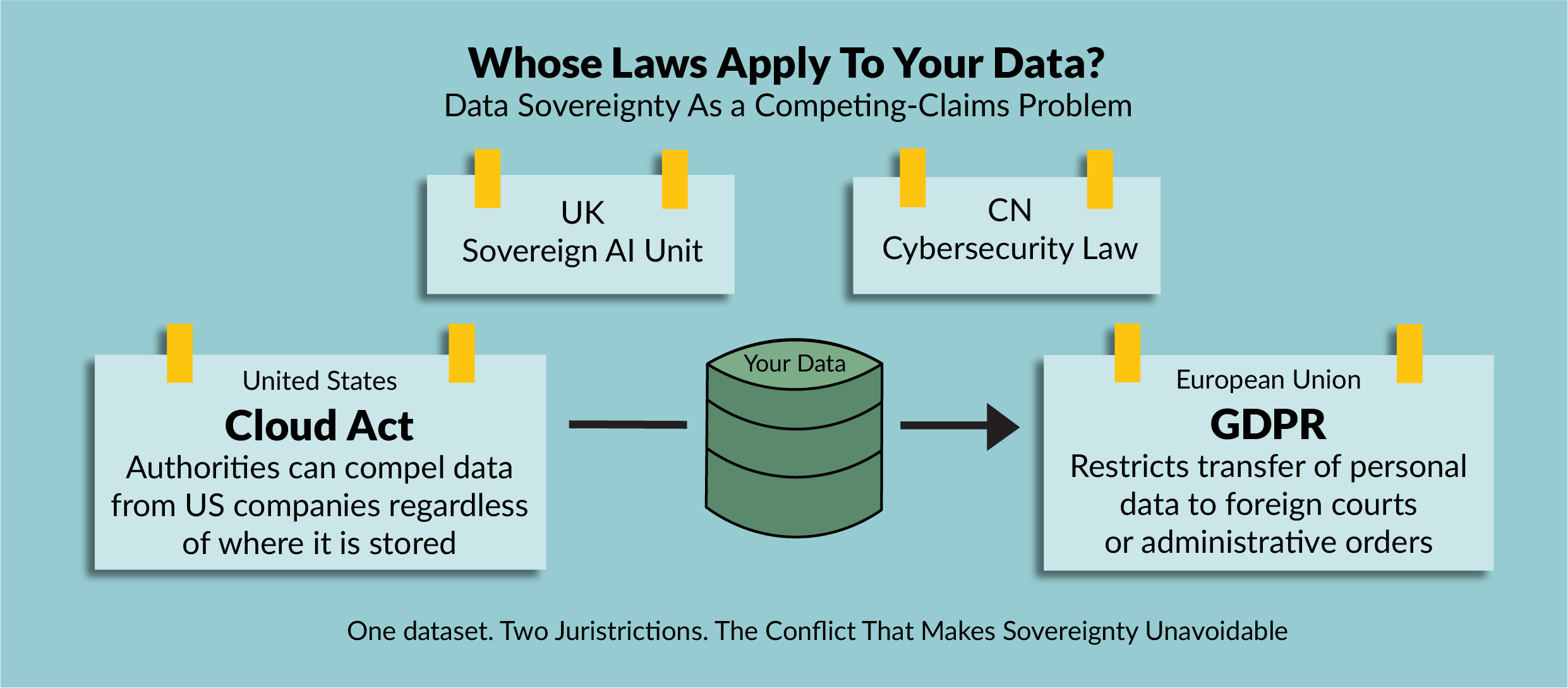
- The problem: Data locality and sovereignty are now highly contested. Laws and compliance frameworks struggle to match the technical speed of change. Organisations find themselves navigating overlapping, and sometimes contradictory, legal regimes. The US CLOUD Act compels US firms to provide data to authorities regardless of where that data is stored. Conversely, the EU’s GDPR restricts personal data exports in response to foreign court or administrative orders. In China, state policy approaches data sovereignty strictly through the lens of national security. The Chinese government mandates domestic storage for citizen data, subjects operators to comprehensive security audits, and positions the state as the ultimate owner of information. Although previously aligned with the EU on some interests, recent US-China trade friction highlights the geopolitical dimensions of data control.
- The implication: Inadequate data sovereignty exposes both companies and citizens to external political influence, legal ambiguity, and disruptions to cross-border digital trade. International service providers are caught in a web of requirements rooted not only in privacy law, but also in economic self-determination and strategic autonomy.
Data Sovereignty and Artificial Intelligence: Regulatory Impact and Business Implications
Artificial intelligence now stands at the centre of this evolving regulatory environment. Governments increasingly connect the advancement and scale of large AI models to national priorities. Developing and running state-of-the-art AI is excessively energy- and water-intensive, but the benefits of domestic development are immense. Direct control of data infrastructure drives substantial domestic and foreign investment, generates valuable intellectual property, creates skilled employment, and produces greater tax revenue.
The alternative is a critical vulnerability. A lack of domestic AI capabilities leads to an over-reliance on foreign models, leaving digital infrastructure at the mercy of other countries' regulators and inbuilt national interests. At a time when economic independence is a global priority, policy is adapting to address this exposure.
The policy response is escalating. The EU AI Act establishes a tiered regulatory regime based on risk level. ‘Unacceptable’ applications, such as social scoring or manipulative AI, are prohibited outright. ‘High risk’ systems are not banned outright, but face strict, granular requirements. Importantly, the Act applies not only to EU-based providers, but also to any third-country operators whose AI affects the EU market.
Sovereign Cloud Solutions in Europe: Data Residency, Compliance, and Provider Selection
While the notion of sovereign AI is fairly new, cloud sovereignty has been a core topic for several years, gaining renewed focus across European industry. Both sovereign AI and sovereign cloud rely on jurisdiction over data centres and the control of data assets.
One major difference, however, is the central issue of data privacy. Cloud architecture raises specific operational risks regarding sensitive information. These risks become obvious when non-EU governments claim access rights to European data, or when global vendors refuse to conform to local compliance regimes. Contractual ownership counts for little when assets reside in legal grey zones or uncooperative countries; effective enforcement remains complex.
The EU directly addresses this through its Sovereignty Objectives, measured with Sovereignty Effectiveness Assurance Levels (SEAL). Providers are quantitatively assessed to calculate a sovereignty score.
Clear industry evidence points to growing demand. The DPP European Media Trends 2026 report reveals that 42% of broadcasters and suppliers are already adopting or seeking specialised ‘Sovereign Cloud’ services. Furthermore, 32% of broadcasters and 29% of suppliers now state that EU-based data residency is a non-negotiable factor in procurement.
UK Policy Initiatives on Cloud Sovereignty and AI Regulation
In the UK, debates over cloud supply chain independence and national digital resilience have gained momentum. This entails a future where the UK owns and operates its entire digital infrastructure. Key challenges remain over what UK cloud sovereignty actually looks like. Solutions span from fully domestic clouds to hybrid and federated models, with the risk that pursuing independence too aggressively could isolate the UK on the international stage.
Other structural questions remain unresolved. The UK must determine its primary priorities in building a sovereign cloud supply chain, as goals such as economic growth, system resilience, and national security all require different operational focuses.
Government support for artificial intelligence is tangible. UK Prime Minister Keir Starmer has framed the country as an ‘AI maker, not just an AI taker’. The creation of a new Sovereign AI Unit, backed by a £500 million funding package for domestic AI development, signals clear political commitment. This demonstrates the political will to strengthen UK data sovereignty over the coming years.
Business Implications of Cloud and AI Sovereignty: What European Organisations Need to Know
Arguments for sovereignty are technical, legal, and commercial. The operational impact is already visible across three key areas:
- Operational continuity: Sovereignty rules shape how broadcasters, platforms, and suppliers maintain service in the global digital market.
- Compliance strategy: Managing both EU and UK standards requires disciplined strategies that secure data flows and preserve business flexibility.
- Procurement mandates: With 42% of the media sector focused on sovereign solutions and roughly one-third making cloud sovereignty a procurement condition, buying decisions now demand evidence-based advice.

Key Requirements for European Organisations Moving Forward
Sovereignty does not equate to technical isolation. The most resilient future will feature interoperable, collaborative ecosystems built on clear property rights and legally enforceable mandates. This structure enables AI to deliver productivity gains, lower research barriers, and broaden access to advanced knowledge. Cloud adoption further reduces upfront capital requirements and enables scalable, security-oriented growth.
Many of the issues surrounding AI and cloud services today stem from one specific problem: unclear data property rights. Who owns the data? Who determines how it can be used? Without sovereignty, these questions are difficult to answer, making the enforcement of property rights nearly impossible.
Persistent uncertainty over data rights and control undermines strategy. Without explicit and enforced sovereignty clauses, European organisations face both operational risk and legal ambiguity. For businesses built on large-scale, cross-border data flows, the clarity of ownership and control is now central to eligibility, growth, and risk management.
If your organisation requires specific, actionable guidance to define a sustainable path through the complex field of AI and cloud sovereignty, contact HNR. Our team combines deep domain expertise with regulatory precision, ensuring your strategies are aligned with both current and emerging standards.

Related News

One Platform, Every Pathway: How a Unified Media Streaming Platform Combines Satellite, 5G and CDN

Sustainability and Legislation Series: Chapter 9 - What the Future Holds

Inside 5G-EMERGE's New Input to MPEG: A Blueprint for Hybrid Satellite Delivery
Ready To Start Saving?
Talk to HNR to reduce carbon emissions and costs from your digital infrastructure.
Book Demo