One Platform, Every Pathway: How a Unified Media Streaming Platform Combines Satellite, 5G and CDN
At the ESA and EBU industry day in Paris on 6 October 2026, part of the 5G-EMERGE Open Industry Workshop, Kris Brown, CTO and co-founder of Humans Not Robots (HNR), presented "One platform, every pathway." His argument was simple. Satellite, 5G, and CDNs should stop working as separate delivery networks. They should work as one coordinated system that decides, in real time, how every viewer gets their stream.
What is a unified media streaming platform?
A unified media streaming platform treats satellite, 5G and CDN delivery as one set of pathways for the same HLS and DASH streams. It works out what audiences are watching and where. It then picks the best pathway for each audience and tells every player to switch over. This happens without breaking the streaming workflows broadcasters and streaming services already run.
Why does today's streaming struggle with large live events?
Most services today deliver HLS or DASH over several CDNs, with each player steered to a CDN. The weakness is that it is all unicast: every viewer pulls their own copy of the stream. When a crowd tunes in to the same live event, the nearest edge point of presence gets congested.
Satellite and 5G Broadcast don't have this problem, because they send a stream once to everyone. But they need a broadcast receiver, such as a satellite tuner or a 5G Broadcast-capable chipset, and a web browser can't use them directly.
What is the M.A.R.S. approach?
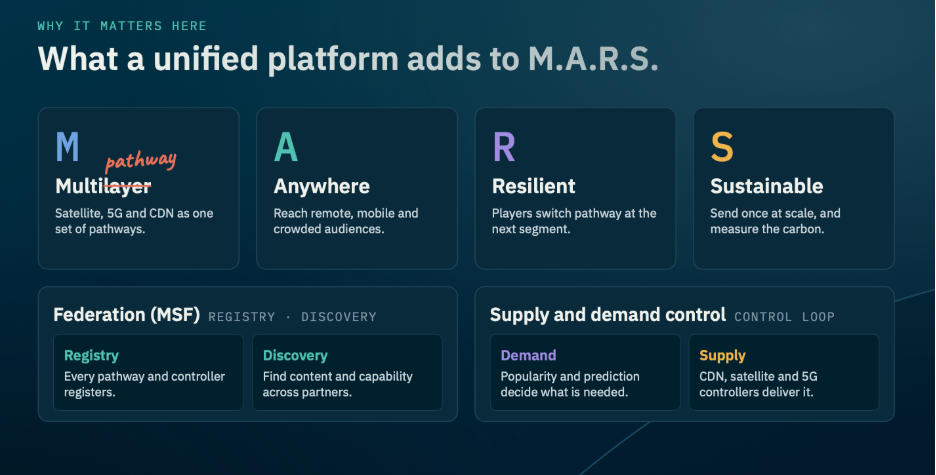
The platform builds on four principles, known as M.A.R.S.:
- Multipathway: satellite, 5G, and CDN work as one set of pathways.
- Anywhere: reach remote, mobile and crowded audiences.
- Resilient: players can switch pathway at the next segment.
- Sustainable: send once at scale and measure the carbon.
How does satellite-enhanced edge delivery (SEED) work?
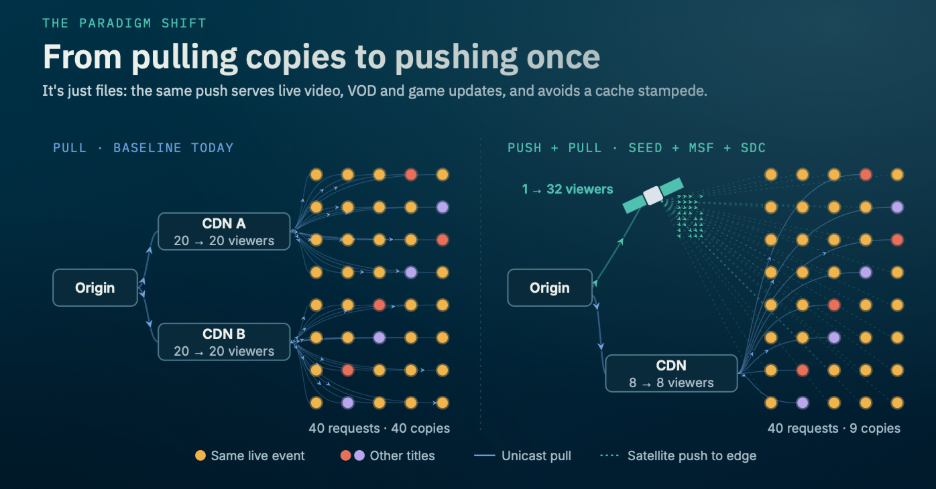
Satellite-Enhanced Edge Delivery (SEED) uses satellite to multicast streams straight into smart edge caches, so every edge is filled at once. The streams are the same ones that arrive over the internet, just by a different pathway, so any standard HTTP player benefits.
SEED also uses 5G. Through network exposure (NEF, via CAMARA APIs), the platform can request Quality on Demand for viewers' sessions, or a network slice for a specific event.
There is a catch. Someone still has to decide what goes where. Today those decisions are made in advance: content is picked ahead of time and transmission systems are configured by hand.
How do MSF and SDC close the coordination gap?
Two layers fill that gap.
Media Streaming Federation (MSF) is a registry and discovery layer. Every pathway and controller registers, and discovery shows what content and capability are available across partners.
Supply and Demand Control (SDC) is the control loop:
- Telemetry from players shows what is being watched, and where.
- Popularity ranks titles from live telemetry, and prediction uses viewing behaviour and the TV schedule to anticipate what comes next.
- Demand control decides what is needed, and supply controllers for CDN, satellite and 5G deliver it. For example, a World Cup final goes out once over satellite to every edge, while Wimbledon gets 5G priority around the grounds.
- Content steering tells every player the new priority. Players move to the better copy seamlessly, and anything not at the edge falls back to unicast.
The result is a system that improves with scale. Every view feeds the ranking, the decision, and where content goes next.
When does sending once save money?
Kris described it as a shift from pulling copies to pushing once. In his example, 40 viewer requests over two CDNs produce 40 copies. With satellite push to the edge alongside CDN, the same 40 requests need just 9 copies. Because it is just files, the same push serves live video, VOD and game updates, and it avoids a cache stampede.
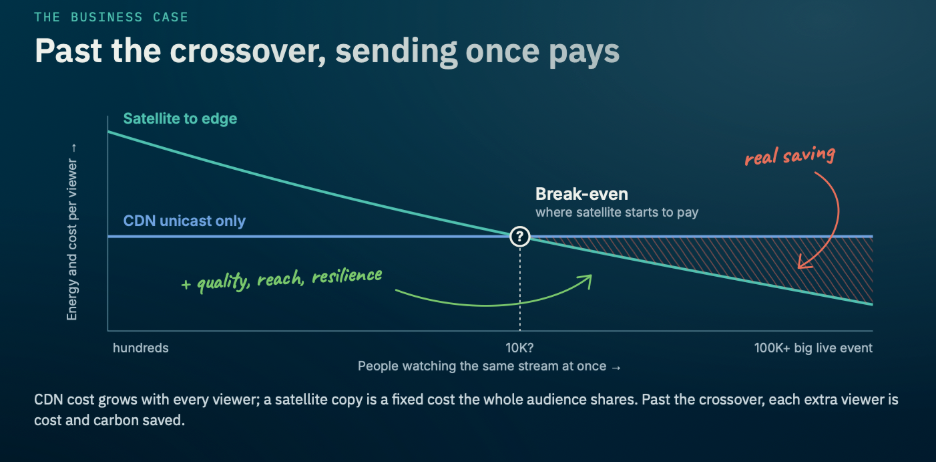
The business case depends on audience size. CDN cost grows with every viewer, while a satellite copy is a fixed cost the whole audience shares. Past the crossover point, which Kris estimated at around 10,000 people watching the same stream at once, each extra viewer saves both cost and carbon. Below that point, satellite still adds quality, reach and resilience.
Who benefits from multipathway streaming?
- Broadcasters and rights holders can reach the biggest live moments at a predictable cost, run satellite-first live events where fixed infrastructure is missing, and serve viewers unicast can't reach well.
- CDNs and network operators can offload peaks, get higher cache utilisation from the same estate, and sell guaranteed quality through network APIs.
- Satellite and NTN operators gain new demand by filling edge caches, not just dishes, and a seat in the internet delivery chain, steered live.
The benefits extend across three groups: consumers (Quality of Experience), providers (Quality of Service) and the planet (Quality of Impact, from fewer duplicate copies). All three are measured the same way, using CMCD, CMSD and OpenTelemetry.
What comes next for 5G-EMERGE?
Phase 3 moves the work into real commercial opportunities for anyone delivering TV, streaming or apps at scale. That includes release-day spikes that hit every edge at once, and live events in congested venues where many streams go in and out at the same time.
See it in action: explore the live demo at demo.5g-emerge.io, or contact Kris Brown at kris@humansnotrobots.com.

Related News
One Platform, Every Pathway: How a Unified Media Streaming Platform Combines Satellite, 5G and CDN

Sustainability and Legislation Series: Chapter 9 - What the Future Holds
Inside 5G-EMERGE's New Input to MPEG: A Blueprint for Hybrid Satellite Delivery
Ready To Start Saving?
Talk to HNR to reduce carbon emissions and costs from your digital infrastructure.
Book Demo