Sustainability and Legislation Series: Chapter 10 - CSRD After the EU Omnibus: Who Is in Scope and When, as of November 2026
By Jesper Risa, Founder Associate at Humans Not Robots
Sustainability reporting legislation moves fast, and since we started this series, there have been enough updates to leave parts of it out of date. Nowhere is this truer than in the EU. Chapter 4 and Chapter 5 were written during a period of rapid change, between the publication of the original CSRD texts and the adoption of the first EU Omnibus. This chapter replaces the timelines in both and describes the position as of November 2026.
Humans Not Robots measures the energy, emissions and cost of technology operations for media and technology companies. We follow these rules closely because they shape the figures our customers are asked for.
Key takeaways
- The CSRD now applies only to EU companies with more than 1,000 employees and more than €450 million in net turnover.
- Newly in-scope EU companies file their first report in 2028, covering FY2027. Non-EU groups report from 2029, covering FY2028.
- The simplified ESRS cut mandatory datapoints by more than 60% and are mandatory from FY2027.
- Companies with up to 1,000 employees are protected by a value chain cap: customers can't ask for more than the voluntary standard covers.
- The CSDDD now applies only to companies with more than 5,000 employees and €1.5 billion in turnover, from 26 July 2029.
- Data centres above 500 kW will receive EU energy and water ratings from A to G, with the first labels expected in 2027.
- Most media and technology suppliers won't report under the CSRD, but will still be asked for energy and emissions figures by customers who do.
What Does This Mean for Media and Technology Companies?
Most broadcasters, streaming platforms and media technology vendors won't report under the CSRD themselves, but many will still be asked for sustainability data by customers who do.
Many media technology vendors and production companies have fewer than 1,000 employees, which puts them under the value chain cap, explained in full below. Their larger customers can still ask for energy use and greenhouse gas emissions, because the voluntary standard covers both, but they can't ask for more than that.
Larger broadcasters and telecoms groups that do fall within the new thresholds will need emissions figures from their technology suppliers, including playout, encoding, CDN and cloud providers, to complete their own reports.
The EU's new rating scheme for data centres above 500 kW will also make hosting choices more visible. Once labels are published from 2027, the energy and water rating of the facilities behind a streaming service will be easy to compare.
Finally, the EU's new greenwashing rules (EmpCo) affect how streaming services and media technology products are marketed to consumers. A service can no longer be described as "carbon neutral" on the strength of offsets alone.
We apply this to ourselves too. When we measured our own carbon footprint for FY2025/26, our absolute emissions rose by 56.8% as our team grew by 45.5%, but revenue per tonne of CO2e improved by nearly three times, from £12,964 to £51,140. For a growing supplier, intensity figures like these tell customers far more than an absolute total.
Timeline: The EU After the Omnibus, 2025 to 2029
Companies must comply with the CSDDD
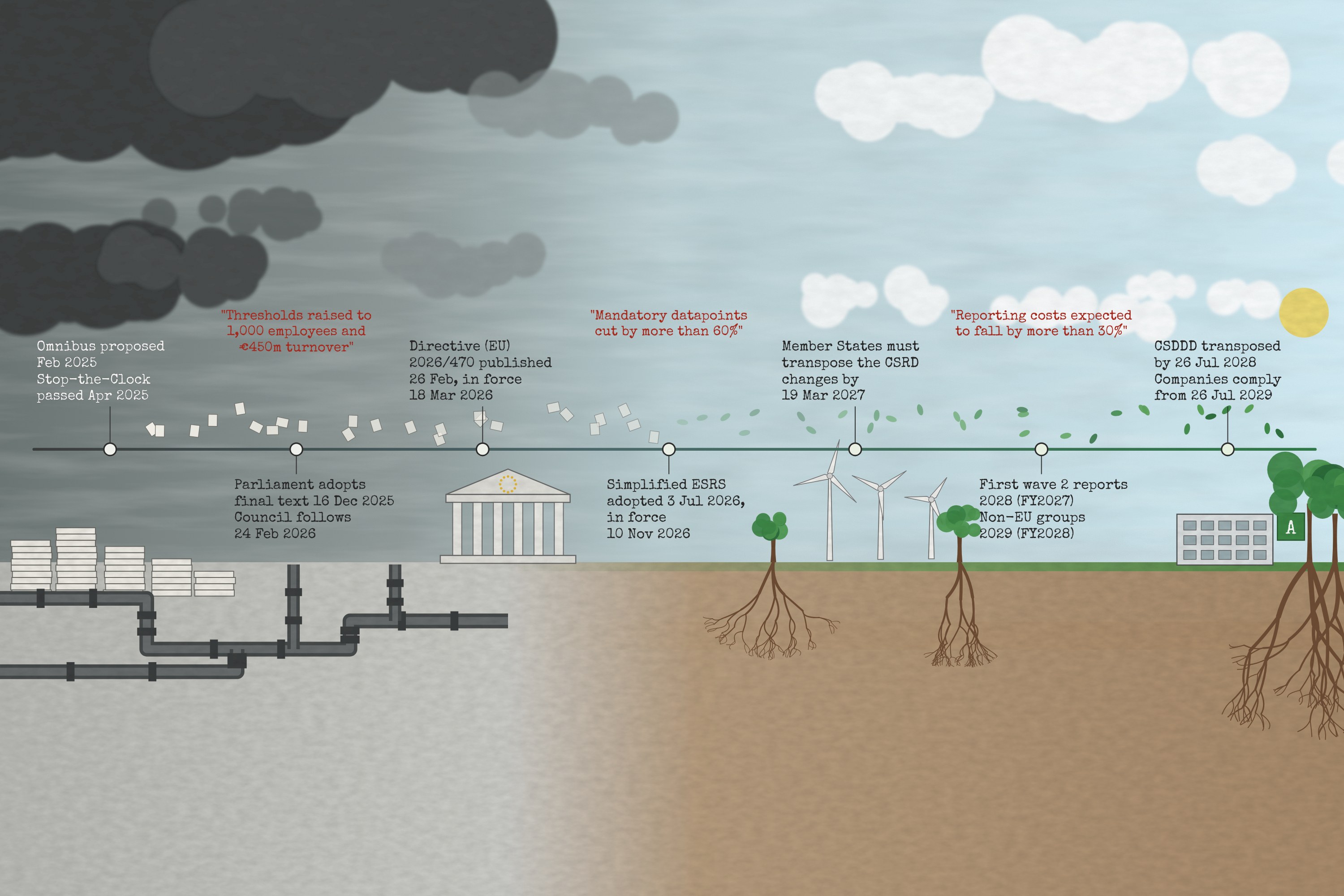
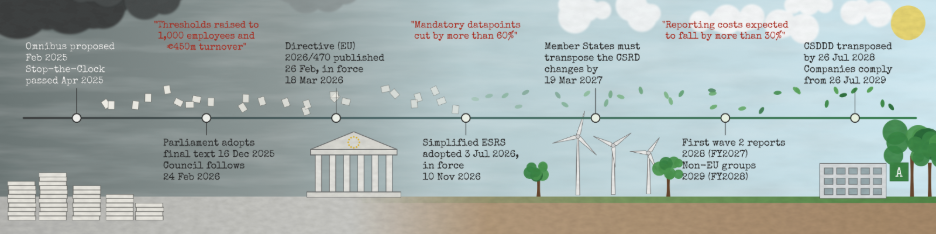
When we published Chapter 5 in January 2026, the European Parliament had approved the Omnibus I Directive, but the Council of the EU had not. Since then, the Council has approved it too, and it was published as Directive (EU) 2026/470, entering into force on 18 March 2026. Member States must now transpose the new rules into national law by 19 March 2027 for the CSRD, and by 26 July 2028 for the CSDDD.
The new rules greatly reduce the scope of both directives, and the standards beneath them have been rewritten as well. Below, we set out who is covered, what they need to report, and when.
Who Is in Scope of the CSRD After the Omnibus?
The Corporate Sustainability Reporting Directive (CSRD) now applies only to EU companies and groups with more than 1,000 employees and more than €450 million in net annual turnover. Both conditions must be met. Under the original rules, a company only had to meet two of three far lower criteria: 250 employees, €50 million in turnover, or €25 million in total assets.
Non-EU groups are in scope if they generate more than €450 million in net turnover in the EU in each of the last two financial years and have an EU subsidiary or branch with more than €200 million in turnover. There is no employee threshold for these groups. They will report for the first time in 2029, covering FY2028, using a separate set of standards for third-country groups that the Commission expects to adopt in 2027.
Several other changes came with the new thresholds:
- Listed SMEs are out. They would have started reporting in 2027 and are now fully exempt.
- Relief for wave 1. Companies in the first wave, which have already reported on FY2024 but now fall below the new thresholds, can be exempted by their Member State for FY2025 and FY2026. From FY2027, they are out of scope regardless.
- Limited assurance only. Reports still need external assurance, but the planned move to the stricter reasonable assurance has been dropped. The Commission must adopt a limited assurance standard by 1 July 2027.
- A value chain cap. Companies in scope can't demand more information from businesses with up to 1,000 employees than the voluntary standard covers (more on this below).
- No sector-specific standards. These have been removed entirely.
For EU companies that are newly in scope, known as wave 2, the first report is due in 2028, covering FY2027.
Is my company in scope?
- EU company or group with more than 1,000 employees and more than €450m turnover: you report under the CSRD. If you haven't reported before, your first report is due in 2028, covering FY2027.
- Non-EU group with more than €450m EU turnover in each of the last two years, and an EU subsidiary or branch above €200m: your first report is due in 2029, covering FY2028.
- Already reporting, but now below the thresholds: check whether your Member State has exempted you for FY2025 and FY2026. From FY2027, you're out of scope.
- Below the thresholds: you're out of scope, but you can report voluntarily. If you have up to 1,000 employees, the value chain cap also limits what your customers can ask of you.
What Changed in the Simplified ESRS?
The simplified European Sustainability Reporting Standards (ESRS) cut mandatory datapoints by more than 60% and the total number of datapoints by more than 70%. The Commission expects reporting costs to fall by more than 30% per company.
The ESRS set out what a CSRD report must contain. The first set, adopted in 2023, was widely criticised for its sheer number of datapoints and for being unclear in places. On 3 July 2026, the Commission adopted a simplified set based on technical advice from EFRAG, the body that drafts the standards. The new standards entered into force on 10 November 2026 and apply directly, with no national transposition needed.
Double materiality, which we covered in Chapter 3, remains at the core. However, companies are now expected to take a top-down approach, starting from their business model and strategy rather than working through every possible topic. Other changes include:
- Companies may leave out information that would seriously prejudice their commercial position, provided this doesn't prevent a fair understanding of the business.
- Companies can choose between the financial control and operational control approaches when setting their greenhouse gas reporting boundary. This brings the ESRS closer to the GHG Protocol and the ISSB standards.
- Companies whose transition plans aren't compatible with 1.5°C must say so.
- Transitional reliefs for reporting anticipated financial effects have been extended.
The simplified ESRS are mandatory for financial years starting on or after 1 January 2027. For FY2026, wave 1 companies can choose between the existing standards, the new ones, or the existing standards with a set of reliefs taken from the new ones. Whichever they choose, they must disclose it.
What Is the Voluntary Standard and the Value Chain Cap?
Companies with up to 1,000 employees can now report using an EU voluntary standard, and their CSRD customers can't ask them for more information than that standard covers. This is known as the value chain cap.
The Commission adopted the standard in July 2026. It is based on EFRAG's Voluntary Sustainability Reporting Standard for SMEs (VSME), which the Commission had previously published as a recommendation. It is now a delegated act, which gives it legal standing, and companies have been able to use it since 24 September 2026.
The standard serves two purposes. The first is to give smaller companies a simple, standardised way to report if they choose to, rather than filling in a different questionnaire for every customer, investor, and bank.
The second is to act as a shield. Under the value chain cap, which applies from FY2027, companies reporting under the CSRD can't require these smaller companies to provide information beyond what the voluntary standard covers. Protected companies have a legal right to refuse, and customers must tell suppliers which of their requests go beyond the cap.
Data requests won't stop, but they should become more predictable and more consistent from one customer to the next.

Who Is in Scope of the CSDDD Now?
The Corporate Sustainability Due Diligence Directive (CSDDD) now applies only to EU companies with more than 5,000 employees and more than €1.5 billion in net worldwide turnover. Non-EU companies are in scope if they generate more than €1.5 billion in net turnover in the EU, with no employee threshold.
The CSDDD requires companies to identify and address the negative impacts of their own operations, and those of their supply chains, on human rights and the environment. Member States must transpose the rules by 26 July 2028, and companies must comply from 26 July 2029. Annual due diligence statements are required for financial years starting on or after 1 January 2030.
The Omnibus also removes or softens several of the directive's original obligations:
- No mandatory transition plan. The requirement to adopt and put into effect a climate transition plan is gone. Companies reporting under the CSRD must still disclose a transition plan if they have one.
- No EU-wide civil liability. The harmonised civil liability regime has been removed. Liability is now mainly a matter for national law, so anyone bringing a claim will have to rely on the rules of individual Member States.
- Capped penalties. Fines are now capped at 3% of net worldwide turnover.
How Has EU Taxonomy Reporting Changed?
Activities that together account for less than 10% of a company's turnover, capital expenditure (CapEx) or operating expenditure (OpEx) no longer need to be assessed for Taxonomy alignment. This is the main change in Delegated Regulation (EU) 2026/73.
The EU Taxonomy defines which economic activities count as environmentally sustainable, and companies under the CSRD must report how much of their turnover, CapEx and OpEx is linked to those activities. Some of the "do no significant harm" criteria for pollution and chemicals have also been simplified.
The regulation applies from 1 January 2026, which means it already covers reports on FY2025, though companies can choose to defer it by one year and report on FY2025 under the previous rules.
Does CBAM Affect My Business?
Unless your business imports steel, aluminium, cement, fertilisers, electricity or hydrogen directly, the Carbon Border Adjustment Mechanism (CBAM) is unlikely to affect you.
CBAM puts a carbon price on those imports. Regulation (EU) 2025/2083 exempts importers bringing in 50 tonnes or less of CBAM goods a year, although the exemption doesn't apply to electricity or hydrogen. This takes around 90% of importers out of the mechanism while still covering about 99% of the emissions.
The definitive period began on 1 January 2026. Importers must buy certificates to cover their 2026 imports, and sales of those certificates start on 1 February 2027.
Beyond the Omnibus
Several other EU rules have moved on since our last update:
- Greenwashing rules now apply. Since 27 September 2026, the Empowering Consumers for the Green Transition Directive (EmpCo) has banned generic environmental claims such as "eco-friendly" or "green" unless the company can demonstrate recognised excellent environmental performance. It also bans claims that a product has a neutral, reduced or positive climate impact based on carbon offsetting. Sustainability labels must now be based on a certification scheme or established by public authorities.
- The 2040 climate target is law. The EU must cut net greenhouse gas emissions by 90% by 2040, compared with 1990 levels. From 2036, high-quality international carbon credits can count for up to five percentage points of that.
- ETS2 is delayed. The second Emissions Trading System, covering fuel for buildings and road transport, now starts in 2028 rather than 2027.
- Data centres will be rated. In September 2026, the Commission adopted a common EU rating scheme for data centres above 500 kW, grading their energy and water performance from A to G. It is currently being scrutinised by the Parliament and the Council, and the first labels are expected in 2027. A separate consultation on minimum performance standards for data centres runs until 14 December 2026.

What Now?
Expect customers to keep asking for figures, and expect claims to be checked more closely. Energy use and greenhouse gas emissions are the numbers to have ready.
Step back from the detail, and the direction of travel is the one we described in Chapter 9: reporting is becoming more digital and more comparable, even as its scope narrows. The companies that will find this easiest are those that already measure their own operations well. If you are looking for a starting point, Chapter 7 sets out practical steps for tech companies.
This is where Humans Not Robots fits in. We measure the energy, emissions and cost of technology operations, giving you the figures your customers will ask for and the evidence to back up the claims you make. If you want to understand what the post-Omnibus rules mean for your business, or to get ready for customer data requests, get in touch.
Frequently Asked Questions
- Who has to report under the CSRD after the Omnibus? EU companies and groups with more than 1,000 employees and more than €450 million in net turnover. Non-EU groups are in scope if they have more than €450 million in EU turnover and an EU subsidiary or branch above €200 million.
- When is the first CSRD report due for newly in-scope companies? EU companies reporting for the first time file in 2028, covering FY2027. Non-EU groups file in 2029, covering FY2028.
- Are SMEs still covered by the CSRD? No. Listed SMEs are now fully exempt. Companies with up to 1,000 employees can report voluntarily using the EU voluntary standard.
- What is the CSRD value chain cap? From FY2027, companies reporting under the CSRD can't require suppliers with up to 1,000 employees to provide more information than the EU voluntary standard covers. Suppliers have a legal right to refuse requests beyond it.
- When do the simplified ESRS apply? They are mandatory for financial years starting on or after 1 January 2027. For FY2026, wave 1 companies can choose between the old standards, the new ones, or the old standards with selected reliefs.
- Who is in scope of the CSDDD now? EU companies with more than 5,000 employees and more than €1.5 billion in net worldwide turnover, and non-EU companies with more than €1.5 billion in EU turnover. Companies must comply from 26 July 2029.
- Can a streaming service still claim to be carbon neutral? Not on the strength of carbon offsets. Since 27 September 2026, EmpCo bans claims of a neutral, reduced or positive climate impact based on offsetting.
Thank you for following along with this series. You can find all ten chapters on our Insights page.

Related News
Sustainability and Legislation Series: Chapter 10 - CSRD After the EU Omnibus: Who Is in Scope and When, as of November 2026

One Platform, Every Pathway: How a Unified Media Streaming Platform Combines Satellite, 5G and CDN

Sustainability and Legislation Series: Chapter 9 - What the Future Holds
Ready To Start Saving?
Talk to HNR to reduce carbon emissions and costs from your digital infrastructure.
Book Demo